

What Is quickconsole com and Why It Sparked So Much Debate
Understanding the context requires separating three layers: conceptual design, claimed quickconsole features, and publicly verifiable deployment evidence. Conceptually, the platform aligns with a growing demand for unified browser consoles that reduce context switching between cloud providers, Git repositories, collaboration apps, and monitoring dashboards. Claimed features include centralized orchestration, anomaly detection, automation triggers, and encrypted session management. However, cloud infrastructure management tools are evaluated through uptime stability, pricing transparency, compliance documentation, and developer ecosystem presence. Without these validation anchors, even well-designed platforms risk being interpreted as amplified digital narratives rather than operational infrastructure. This analysis examines quickconsole com through a professional lens, comparing it against established cloud providers and observability tools while assessing its potential suitability for startups versus enterprise environments.quickconsole features and Core Architecture Breakdown
The quickconsole features commonly referenced include centralized dashboards, developer console automation, real-time cloud monitoring panels, and multi-cloud orchestration controls. In theory, the platform functions as an overlay layer rather than a raw infrastructure provider. This distinction matters because quickconsole com is not intended to replace compute engines like AWS or Azure but to consolidate operational visibility across them. The architectural appeal lies in workflow simplification. Developers often manage multiple dashboards simultaneously, switching between serverless deployment tools, monitoring interfaces, and collaboration environments. A unified browser console can reduce friction by aligning these components into one control surface. If implemented effectively, such consolidation directly improves DevOps workflow optimization by minimizing manual coordination overhead and shortening response cycles during incidents. Another architectural element often associated with quickconsole com is secure API management. Cross-platform orchestration requires controlled API token handling, encrypted sessions, and access role enforcement. A mature orchestration platform would log API calls, support audit trails, and provide usage tracking visibility. Real-time cloud monitoring components would ideally expose telemetry data such as resource utilization, container health metrics, and deployment triggers. These features collectively form the backbone of cloud infrastructure management environments. However, consistent public documentation and transparent operational evidence are essential for validating such claims. Conceptual architecture aligns with current DevOps demands, but sustained technical verification ultimately determines credibility within competitive monitoring ecosystems.quickconsole vs Cloud Providers and Observability Platforms
When evaluating quickconsole vs cloud providers, it is critical to understand that hyperscale providers deliver infrastructure foundations rather than orchestration overlays. AWS, Azure, and Google Cloud operate data centers, compute networks, and database clusters. Quickconsole com, as described, would sit above those layers to coordinate deployments, monitor services, and centralize developer console automation workflows. That strategic positioning makes sense because organizations increasingly operate in multi-cloud environments. A management layer simplifying multi-cloud orchestration can reduce operational duplication. However, cloud providers themselves offer native monitoring dashboards, API gateways, and compliance reporting. Therefore, quickconsole com must demonstrate added value beyond aggregation to compete for attention in this space. Comparing quickconsole vs Datadog and New Relic introduces a deeper benchmark. Datadog and New Relic provide enterprise-grade observability, distributed tracing, infrastructure telemetry, and documented compliance standards. Their DevOps workflow optimization capabilities extend into predictive alerting and performance analytics at scale. Quickconsole com, based on available evaluation patterns, appears more aligned with lightweight workflow centralization rather than advanced observability analytics. Where Datadog and New Relic dominate in telemetry granularity and enterprise audit readiness, quickconsole com positions itself around simplification and dashboard consolidation. This distinction shapes its likely adoption profile: startups and small teams seeking coordination efficiency rather than enterprises requiring regulated observability depth.Enterprise vs Startup Suitability
Enterprise cloud infrastructure management demands deterministic reliability, regulatory transparency, and documented compliance safeguards. Organizations handling sensitive financial or healthcare data require encrypted audit trails, penetration testing disclosures, structured role-based access control, and detailed uptime guarantees. Established observability platforms satisfy these criteria through audited compliance certifications and extensive telemetry ecosystems. Quickconsole com, while conceptually aligned with developer console automation and secure API management, would need consistent compliance documentation and SLA clarity to serve enterprise environments confidently. Without such validation layers, enterprise IT governance teams may treat it cautiously rather than as a production backbone. Startup environments operate under different constraints. Early-stage teams prioritize agility, speed, and operational clarity over regulatory complexity. They frequently manage multiple cloud services without dedicated infrastructure engineers. For these teams, centralized multi-cloud orchestration and simplified real-time cloud monitoring dashboards can produce immediate productivity gains. Reducing tab switching and aligning workflows inside a browser-based console directly improves DevOps workflow optimization in lean teams. If quickconsole com functions as described in consolidation-focused narratives, it naturally aligns more with startup and freelance developer ecosystems. The difference between enterprise and startup suitability therefore lies less in conceptual feature strength and more in compliance transparency and operational maturity signals.Pros and Cons of quickconsole com
[caption id="attachment_2034" align="aligncenter" width="1024"]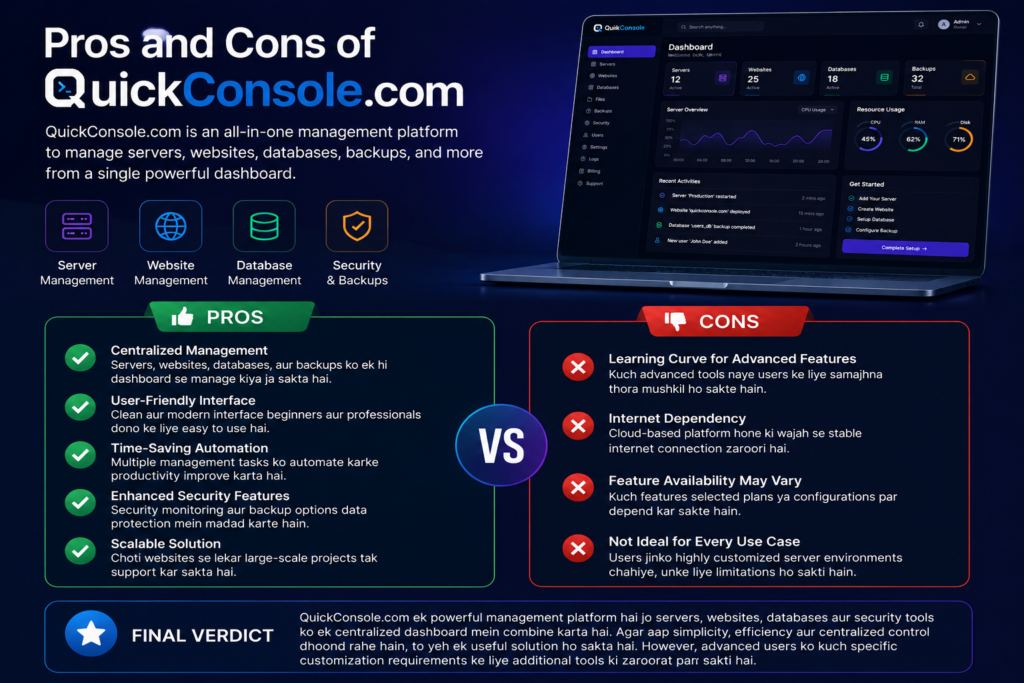 Complete pros vs cons breakdown of quickconsole com cloud infrastructure management platform[/caption]
| Category | Pros | Cons |
|---|---|---|
| Cloud Infrastructure Management | Centralized dashboard simplifies multi-cloud orchestration | Limited publicly verifiable compliance documentation |
| Developer Console Automation | Browser-based access reduces installation complexity | Not positioned as a full IDE replacement |
| Real-Time Cloud Monitoring | Consolidated visibility across services | Depth of telemetry unclear compared to enterprise tools |
| DevOps Workflow Optimization | Reduces context switching between tools | Enterprise-grade SLA transparency not clearly established |
| Secure API Management | Conceptual encrypted session design | Public audit and compliance frameworks not consistently visible |
| Startup Suitability | Lightweight coordination layer for small teams | May lack depth for large-scale enterprise observability |
| Pricing Transparency | Potential flexibility for small teams | Structured quickconsole pricing tiers not clearly documented |