

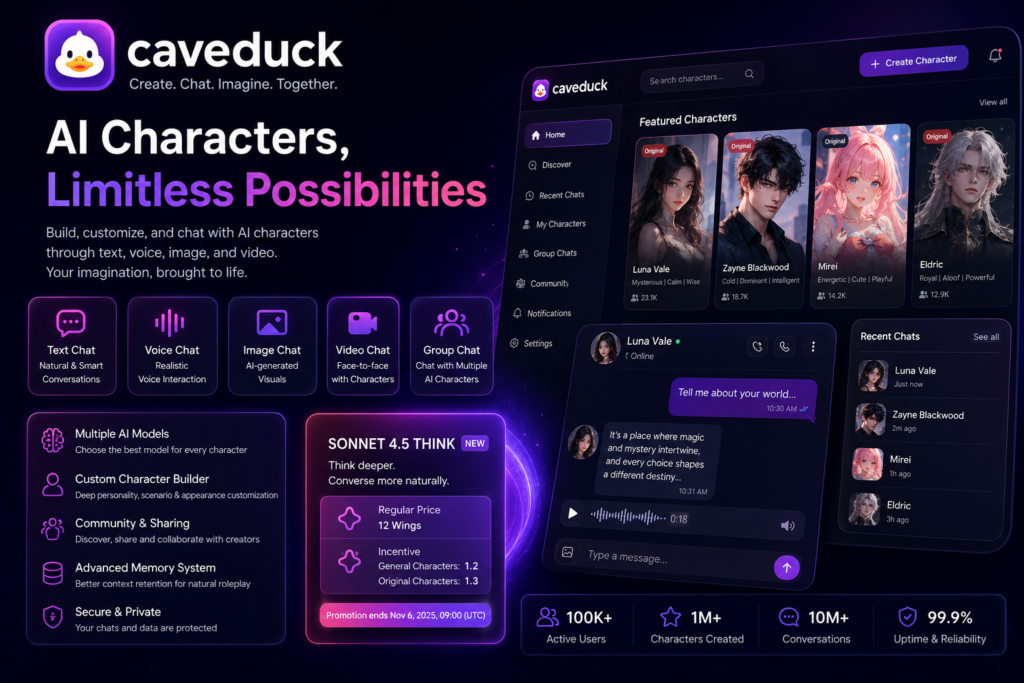
Inside the Architecture of the caveduck AI Platform
Many reviews focus solely on the front-end experience, but understanding the underlying design reveals why caveduck has attracted creative writers, roleplay enthusiasts, and game developers. At its core, the platform functions as a multi-model orchestration layer. Users can select different AI engines depending on the conversational depth, reasoning capabilities, response style, or cost efficiency they require. This model flexibility prevents the common problem of being locked into a single AI provider whose strengths may not align with every character type. The backend also appears optimized for token generation optimization across lengthy roleplay sessions. Traditional AI systems often allocate context inefficiently, causing personality drift as conversations grow longer. caveduck attempts to balance active context with character-specific instructions, helping preserve behavioral consistency. While memory performance still varies depending on the selected model, the architecture suggests a deliberate effort to prioritize character persistence. For roleplay-heavy environments, this design matters because users frequently engage in narratives that span hundreds or even thousands of conversational exchanges.Character Creation and Virtual Character Customization
The strongest feature within caveduck is undoubtedly its character-building environment. The platform supports extensive virtual character customization that goes far beyond the standard chatbot configuration process. Users can establish detailed personality frameworks, conversational boundaries, emotional triggers, relationship dynamics, and communication preferences. This level of control allows creators to develop highly specialized personas tailored for storytelling, entertainment, education, or experimentation. Another advantage is the ability to integrate visual identity alongside conversational behavior. Since caveduck supports image interactions in addition to text exchanges, creators can align a character's appearance with its personality profile. This consistency helps strengthen immersion, especially for users participating in long-form roleplay scenarios. Community publishing tools further enhance the ecosystem by allowing creators to share, refine, and iterate on character designs over time. As a result, characters evolve through collective feedback rather than remaining static creations. Advanced AI Memory Architecture and Long-Term Conversations A major challenge facing every free ai roleplay chatbot platform is memory retention. Maintaining coherent personalities over extended interactions requires more than storing conversation history. Effective systems must determine which information deserves persistence, which details should remain temporary, and how personality instructions interact with ongoing narrative development. This is where advanced ai memory architecture becomes particularly important. caveduck appears to use layered contextual management rather than relying exclusively on raw chat history. Character definitions remain separated from active conversational context, allowing foundational personality traits to persist even when conversations become lengthy. However, memory consistency still depends on the selected language model. Some models demonstrate stronger recall and behavioral stability than others. Users seeking highly persistent companions should therefore evaluate model selection carefully. While no current platform has completely solved memory degradation, caveduck demonstrates a more sophisticated approach than many competitors that simply append previous messages into a growing conversation log.caveduck Pros and Cons
| Pros | Cons |
|---|---|
| Strong interactive character generation tools | Premium features require subscription access |
| Multiple AI model choices | Memory consistency varies by model |
| Supports text, image, voice, and video interactions | Advanced functionality can overwhelm beginners |
| Community-driven character sharing | Some premium models increase usage costs |
| Group chat functionality | Learning curve for advanced customization |
| Flexible character design system | Free tier limitations affect heavy users |
- The multi-model architecture provides flexibility rarely found in competing character platforms.
- Memory quality and conversation persistence remain dependent on the specific model selected by the user.
caveduck vs Character AI and Other Alternatives
| Feature | caveduck | Character AI | JanitorAI |
|---|---|---|---|
| Multi-Model Support | Yes | Limited | Partial |
| Voice Interaction | Yes | Yes | Limited |
| Video Interaction | Yes | No | No |
| Group Conversations | Yes | Limited | Partial |
| Community Publishing | Strong | Strong | Moderate |
| Character Customization | Extensive | Moderate | Extensive |
| Multi-Modal Experience | Advanced | Basic | Moderate |
| AI Model Flexibility | High | Low | Medium |
- Users comparing caveduck vs character ai often cite model flexibility and multimedia support as major differentiators.
- Character AI remains easier for casual users, while caveduck provides greater customization depth for advanced creators.
- "If you are interested in how decentralized models compare to standard conversational bots, check out our deep dive into [DeepSeek AI Chatbots or ChatGPT models