

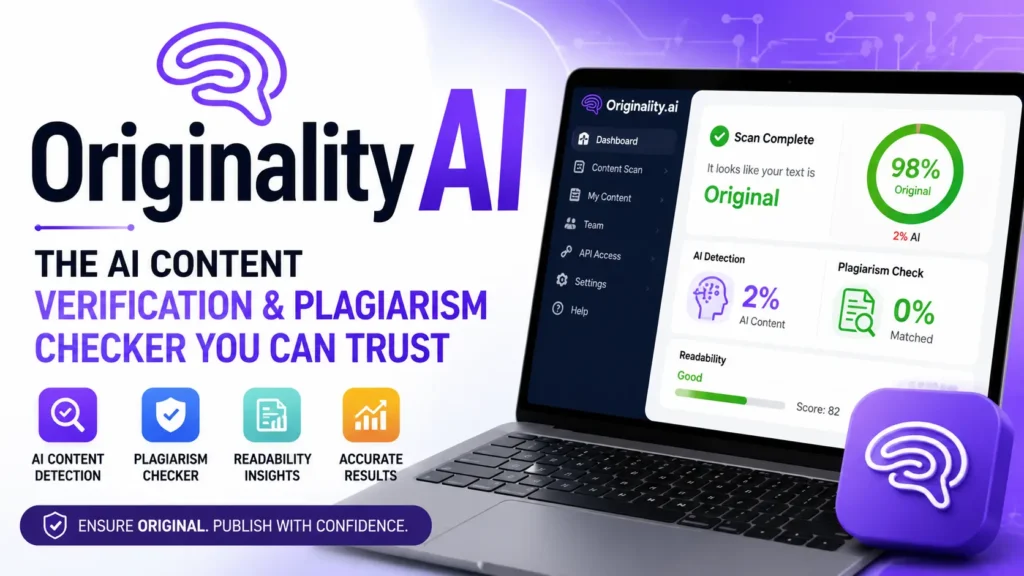
What Is Originality AI
Originality AI is an online tool that combines AI content detection and plagiarism checking into a single platform. It is specifically built for content publishers, SEO agencies, content marketing teams, and anyone who needs to verify the authenticity and originality of written content before publishing or submitting it. Unlike general purpose plagiarism checkers that only compare text against existing web content, Originality AI goes a step further by also analyzing whether the text was likely generated by AI writing tools. This dual functionality makes it particularly valuable in the current content landscape where AI generated text may not match any existing online source but is still not original human written content. The tool was developed with a focus on serving the needs of professional content teams. Many businesses and agencies outsource their content creation to freelancers and content writers. Originality AI provides these organizations with a reliable way to verify that the content they are paying for is genuinely human written and free from plagiarism. The platform uses advanced machine learning models that are trained to recognize patterns and characteristics typical of AI generated text. These models are continuously updated to keep pace with the latest developments in AI writing technology, which means the tool remains effective even as new and more sophisticated AI writing tools are released. Originality AI supports scanning of content in multiple formats and allows users to check content directly by pasting text into the interface or by providing a URL for web page scanning. This flexibility makes it convenient for different types of users and use cases.How Originality AI Works
Understanding the technology behind Originality AI helps users appreciate its capabilities and limitations. The tool uses two distinct processes to analyze content which together provide a comprehensive assessment of text authenticity. The AI detection component uses machine learning models that have been trained on large datasets of both human written and AI generated text. These models learn to identify statistical patterns, writing characteristics, and structural features that are commonly associated with AI generated content. When a piece of text is submitted for analysis, the model calculates the probability that the text was generated by an AI tool and presents this as a percentage score. According to research on machine learning and natural language processing published by Google AI, modern language models generate text by predicting the most statistically likely next word or phrase based on the context of the preceding text. This process creates certain detectable patterns in the output that differ from the more varied and less predictable patterns found in human written text. Originality AI exploits these differences to make its AI detection assessments. The plagiarism detection component works by comparing submitted text against a large database of existing online content. When similarities are found between the submitted text and existing sources, the tool highlights these matches and identifies the original sources. This helps users identify whether any part of the content has been copied from elsewhere on the internet. The combination of these two detection methods gives users a more complete picture of content authenticity than either method alone could provide. A piece of content might pass plagiarism checking because it was generated by AI and does not match any existing source, but still fail the AI detection check. Having both checks in a single tool ensures that nothing slips through the net. Results are presented in a clear and easy to understand format. Users receive an AI probability score, a plagiarism percentage, and highlighted sections of text that triggered either detection method. This detailed reporting allows users to make informed decisions about the content they are reviewing. .Key Features of Originality AI
Originality AI offers a comprehensive set of features that make it a powerful tool for content verification. These features are designed to meet the needs of professional content teams and individual users alike.Table 1: Key Features of Originality AI
| Feature | Description | User Benefit |
|---|---|---|
| AI Content Detection | Identifies AI generated text with probability score | Verify human written content |
| Plagiarism Checking | Compares text against online sources | Detect copied content |
| URL Scanning | Scan published web pages directly | Check live content quickly |
| Team Management | Add team members and manage accounts | Suitable for agencies and teams |
| Scan History | Access previous scan results | Track content verification over time |
| Readability Score | Assess content readability level | Improve content quality |
| Fact Checking | Identify potential factual inaccuracies | Enhance content accuracy |
| API Access | Integrate with other tools and workflows | Automate content checking |
Who Should Use Originality AI
Originality AI is designed for a specific audience of professional content users. Understanding who benefits most from the tool helps potential users decide if it meets their needs. Content publishers and blog owners who accept guest posts or outsource content creation will find Originality AI invaluable. Without a reliable verification tool, it is difficult to know whether submitted content is genuinely human written. Originality AI provides the assurance needed to maintain content quality standards. SEO agencies that manage content for multiple clients need to ensure that all published content meets quality standards. Google has made it clear through its helpful content guidelines that content should be created for people, not for search engines. Using Originality AI helps agencies verify that content meets these standards before it is published. Educators and academic institutions can use Originality AI to detect AI generated content in student submissions. As AI writing tools become more accessible to students, maintaining academic integrity requires tools that can identify AI generated work alongside traditional plagiarism detection. Freelance writers can use Originality AI to verify their own content before delivering it to clients. This proactive approach demonstrates professionalism and gives clients confidence in the quality and authenticity of the work they receive. Human resources teams that review job applications and written assessments can use the tool to verify that application materials are genuinely written by the applicants rather than generated by AI tools.Accuracy of Originality AI
Accuracy is the most important factor when evaluating any content detection tool. A tool that produces too many false positives or false negatives is not reliable enough for professional use. Originality AI has built its reputation on being one of the more accurate AI detection tools available. The tool claims high accuracy rates for detecting content generated by major AI writing tools including ChatGPT, GPT-4, Jasper, Copy AI, and others. However it is important to understand that no AI detection tool is perfect. The field of AI detection is an ongoing arms race between detection tools and AI writing tools that are constantly improving. False positives occur when the tool incorrectly identifies human written content as AI generated. This can happen with certain writing styles that happen to share characteristics with AI generated text. Users should treat AI detection scores as one factor in their content verification process rather than as an absolute and definitive judgment. False negatives occur when AI generated content passes through the detection system undetected. As AI writing tools become more sophisticated and produce more varied and natural sounding text, detection becomes more challenging. Originality AI continuously updates its models to address this challenge. The plagiarism detection component is generally reliable for identifying content that has been copied from web sources. However it can only detect plagiarism from sources that are indexed in its database. Content copied from obscure or non indexed sources may not be detected.Originality AI Pricing and Plans
Understanding the cost structure of Originality AI helps users determine if it fits their budget and usage requirements. Originality AI uses a credit based pricing model where users purchase credits that are consumed each time they scan content. This pay as you go approach is flexible and allows users to pay based on their actual usage rather than committing to a fixed monthly fee regardless of how much they use the tool. One credit typically allows the scanning of a certain number of words. The exact word count per credit may vary and users should check the official platform for the most current pricing information. This credit system means that occasional users are not locked into expensive subscriptions while heavy users can purchase credit bundles at reduced rates. The team plan allows multiple users to share a pool of credits under a single account. This is particularly useful for agencies and content teams where multiple people need access to the scanning tool. Team plans often include additional management features that are not available on individual accounts. API access is available for users who want to integrate Originality AI into their own tools and workflows. API pricing is typically separate from the standard credit system and may be structured differently based on usage volume.Table 2: Originality AI Pricing Overview
| Plan Type | Cost Structure | Best For | Key Features |
|---|---|---|---|
| Pay As You Go | Credits per scan | Occasional users | Basic scanning features |
| Credit Bundles | Bulk credits at discount | Regular users | Cost effective scanning |
| Team Plan | Shared credits, multiple users | Agencies, content teams | Team management features |
| API Access | Usage based pricing | Developers, tech users | Integration capabilities |
Originality AI vs Other Detection Tools
The AI content detection market has grown quickly and several tools now compete with Originality AI. Understanding how they compare helps users choose the best option for their needs. Copyleaks is a well established plagiarism detection platform that has added AI detection capabilities. It offers a broader range of features including support for multiple languages and file formats. However some users find Originality AI more focused and accurate for AI detection specifically. Turnitin is the dominant tool in academic plagiarism detection and has introduced AI detection features. However it is primarily designed for educational institutions and may not be the most practical option for content publishers and marketing agencies. GPTZero is a free tool that focuses specifically on AI detection without plagiarism checking. While the free access is appealing, its accuracy and feature set are generally considered less comprehensive than Originality AI for professional use cases. Winston AI is another competitor that offers both AI detection and plagiarism checking. It is similar in concept to Originality AI but may differ in accuracy rates, pricing, and specific features.Table 3: Originality AI vs Competitor Tools
| Feature | Originality AI | Copyleaks | GPTZero | Winston AI | Turnitin |
|---|---|---|---|---|---|
| AI Detection | Yes | Yes | Yes | Yes | Yes |
| Plagiarism Checking | Yes | Yes | No | Yes | Yes |
| Team Management | Yes | Yes | No | Yes | Yes |
| URL Scanning | Yes | Limited | No | Yes | No |
| API Access | Yes | Yes | Yes | Yes | Limited |
| Free Plan | No | Limited | Yes | Limited | No |
| Pricing Model | Credits | Subscription | Free and Paid | Subscription | Institutional |
| Focus | Content publishers | Education and business | General users | Content publishers | Education |
Practical Use Cases for Originality AI
Understanding how Originality AI is used in real world scenarios helps potential users see its practical value. Content agencies use Originality AI as part of their quality control process. Before delivering content to clients every article is scanned to ensure it passes both AI detection and plagiarism checks. This protects the agency's reputation and provides clients with assurance about content quality. SEO professionals use the tool to audit content on their websites and client websites. As search engines like Google continue to refine their ability to identify and potentially penalize AI generated content that lacks value, having a way to verify content authenticity is important for maintaining search rankings. Online course creators and educators use Originality AI to evaluate student submitted work. With AI writing tools becoming increasingly accessible to students, maintaining academic integrity requires robust detection capabilities. Journalists and fact checkers use the tool as part of their verification process when reviewing submitted articles, press releases, and other written materials. The combination of AI detection and plagiarism checking helps ensure that published content meets professional standards. Book publishers and literary agents can use Originality AI to verify submitted manuscripts and writing samples. As AI generated books and stories become more common, the ability to identify AI involvement in creative writing becomes increasingly relevant.Strengths of Originality AI
Originality AI has several notable strengths that have contributed to its reputation as a leading content detection tool. The combination of AI detection and plagiarism checking in a single platform is a significant advantage. Most competing tools focus on one or the other but having both capabilities available together simplifies the content verification workflow considerably. The tool is specifically designed for professional content teams which means its features and interface are optimized for the needs of agencies, publishers, and content managers rather than being a general purpose tool adapted for content detection. Regular model updates ensure that the AI detection capabilities remain effective against the latest AI writing tools. The team behind Originality AI actively monitors developments in the AI writing space and updates the detection models accordingly. The team management features make it practical for organizations of different sizes to use the platform efficiently. Multiple team members can access shared credits and the platform provides oversight tools for managing team usage. Clear and detailed reporting makes it easy for users to understand and act on the results of their scans. The visual presentation of AI probability scores and plagiarism matches helps users make quick and informed decisions.Limitations of Originality AI
Like any tool Originality AI has limitations that users should be aware of before committing to the platform. No AI detection tool is 100 percent accurate. False positives and false negatives are inevitable given the current state of the technology. Users should treat Originality AI results as a strong indicator rather than an absolute verdict on content authenticity. The credit based pricing model may not be the most cost effective option for very high volume users who need to scan large amounts of content regularly. These users may find subscription based alternatives more economical depending on their scanning volume. The tool is primarily effective for content written in English. Detection accuracy for content in other languages may be lower which limits its usefulness for multilingual content teams. AI writing technology is advancing rapidly. As new and more sophisticated AI writing models are released, there will always be a period where the detection tool needs to catch up. During this transition period some AI generated content may not be detected reliably.Tips for Using Originality AI Effectively
Getting the most out of Originality AI requires understanding how to interpret and act on the results it provides. Always use the AI detection score alongside other quality signals when evaluating content. A high AI probability score should prompt a closer review of the content rather than automatic rejection. Some legitimate human written content may score higher than expected due to writing style or subject matter. Scan content before making any edits or revisions. Edited AI generated content may score differently than the original version which can make it harder to get an accurate picture of the original content's authenticity. Use the URL scanning feature to periodically check published content on your website. This can help identify any content that may have been published without proper verification or that has since been copied by other websites. Take advantage of the team management features to establish consistent content verification standards across your organization. Requiring all content to pass Originality AI scans before publication creates a systematic quality control process. Combine Originality AI scanning with other content quality checks such as readability assessment, fact checking, and editorial review. A comprehensive quality control process produces the best results.Table 4: Best Practices for Using Originality AI
| Best Practice | Why It Matters | How to Apply |
|---|---|---|
| Scan before editing | Get accurate baseline scores | Run scan on original submitted content |
| Use alongside other quality checks | Comprehensive content verification | Combine with editorial review |
| Interpret scores in context | Avoid false positives affecting good content | Review flagged sections manually |
| Scan URL of published content | Monitor existing content quality | Regular audits of website content |
| Use team features for consistency | Standardize verification process | Set organization wide scanning requirements |
| Keep detection purpose clear | Maintain ethical use of tool | Use as quality tool not punishment tool |
| Stay updated on accuracy claims | Understand tool limitations | Follow Originality AI updates and news |
| Use API for workflow integration | Automate verification process | Build scanning into content management system |
Pros and Cons of Originality AI
Pros vs Cons Table
| Pros | Cons |
|---|---|
| Combines AI detection and plagiarism checking | No free plan available |
| Specifically designed for content professionals | Credit based pricing can be costly at high volume |
| Regular model updates for latest AI tools | Not 100 percent accurate, false positives possible |
| Team management features for agencies | Primarily effective for English language content |
| Clear and detailed scan reporting | AI generated content paraphrasing may evade detection |
| URL scanning for published content | Results should be used as indicator not absolute verdict |
| API access for workflow integration | Learning curve for API integration |
| Readability and fact checking features | Some features still in development |
| Protects content quality and brand reputation | Requires internet connection for all scanning |
| Continuously improving detection models | Pricing transparency could be improved |