

What Is RNDCoin Blockchain?
RNDCoin Blockchain is the distributed ledger infrastructure associated with rndcoin.kr, a South Korean crypto platform founded in 2019 and headquartered in Incheon. The project markets itself under the ambitious label "Blockchain Total Service" — suggesting it wants to function as a full-spectrum ecosystem covering news, education, wallet functionality, smart contract support, and decentralized application tools, all tailored specifically for Korean-speaking users and the broader South Korean digital finance market. What makes RNDCoin Blockchain particularly difficult to evaluate fairly is the sharp gap between what is claimed in its marketing and what is independently verifiable through public documentation. The platform's educational structure — including a 12-part Bitcoin course called "Coin Lectures" and crypto news curated for Korean audiences — is genuinely observable. Claims about smart contract functionality, hybrid consensus mechanisms, and thousands of transactions per second are also present across multiple sources, but independent verification through GitHub repositories, third-party security audits, or on-chain explorer data is not publicly confirmed as of mid-2026. Responsible evaluation requires holding both of these realities simultaneously rather than defaulting entirely to either promotional enthusiasm or blanket dismissal.How Does RNDCoin Blockchain Work?
The technical architecture of RNDCoin Blockchain, as described across available documentation, is built around a Proof-of-Stake or hybrid PoS/DPoS (Delegated Proof-of-Stake) consensus model. Under this framework, participants stake their tokens to validate transactions rather than consuming energy through the computational mining process that Proof-of-Work systems like Bitcoin require. Validators are selected based on their staked holdings and, in a delegated variant, community members vote for trusted representatives to handle validation on their behalf. This structure theoretically allows for near-instant block times and transaction fees measured in fractions of a cent — the exact characteristics needed for everyday payment utility. The claimed transaction flow follows a standard distributed ledger sequence: a user initiates a transfer through a compatible wallet, the request is broadcast to network nodes, validators confirm the transaction against consensus rules, the approved transfer is recorded permanently in a new block, and the network state updates across all participating nodes simultaneously. If the smart contract layer is functional as described, developers can also deploy automated digital agreements that execute predefined conditions without human intervention — enabling use cases in payments automation, governance voting, and decentralized application logic. The critical qualification that honest analysis demands: these architectural descriptions exist primarily in marketing materials and secondary articles. A verified GitHub repository with active commit history, a publicly accessible blockchain explorer showing live transaction data, and an independently audited smart contract codebase — the standard verification tools for any serious blockchain claim — are not confirmed as publicly available for RNDCoin Blockchain at this time.Key Features of RNDCoin Blockchain
Energy-Efficient Consensus Mechanism
The shift away from Proof-of-Work is one of the most consequential architectural decisions any modern blockchain can make. Traditional PoW systems like Bitcoin require enormous computational hardware running continuously, consuming electricity at rates comparable to small countries. RNDCoin Blockchain's claimed PoS or hybrid consensus model eliminates this by replacing hardware competition with economic stake. Validators commit tokens as collateral, creating financial accountability for honest behavior without the environmental cost. For Korean developers and users increasingly conscious of ESG considerations in technology adoption, this positions the network more favorably than legacy alternatives. The practical energy advantage is real — if the consensus mechanism operates as described. Solana and Ethereum's post-merge architecture both demonstrate that PoS can achieve high throughput at minimal energy expenditure when implemented correctly.Smart Contract and dApp Support
Smart contract functionality represents the dividing line between a simple payment token and a programmable blockchain platform. RNDCoin Blockchain claims to support automated digital agreements — code that executes independently when specified conditions are met, without requiring trusted intermediaries to enforce outcomes. If this infrastructure operates as described, it opens the platform to decentralized finance applications, automated business workflows, digital identity verification systems, NFT issuance, and supply chain tracking tools. The developer ecosystem reportedly includes technical documentation, sandbox testing environments, and community grant programs to encourage third-party application building. Practically speaking, a smart contract layer is only as valuable as the volume of verified deployments on top of it. For context, Ethereum hosts over 44 million smart contracts. The observable dApp ecosystem on RNDCoin Blockchain is not documented in any publicly verifiable format at the current time.Wallet Infrastructure and Token Management
The platform supports a mobile wallet for storing, sending, and receiving digital assets, with an association to Reddcoin (RDD) — a pre-existing Proof-of-Stake Velocity cryptocurrency from 2014 — documented as part of the wallet's supported assets. For users, this means accessing staking rewards by holding coins within the wallet interface rather than needing separate staking infrastructure. The wallet is reportedly ERC20-compatible, meaning it functions alongside MetaMask, Trust Wallet, Ledger hardware wallets, and other standard Web3 wallet tools. This compatibility detail is more significant than it first appears: ERC20 compatibility implies the token may operate on Ethereum's infrastructure rather than a fully independent native blockchain — which would mean the "RNDCoin Blockchain" framing refers to the broader ecosystem and the Ethereum network's security layer rather than an entirely separate distributed ledger.Localized Korean Crypto Education Hub
This is the platform's most consistently documented and independently observable feature. RNDCoin KR curates Korean-language cryptocurrency news, publishes structured educational content designed for beginners entering the crypto market, and maintains community connections through Korean blockchain forums including Steemit-linked discussions. The "Coin Lectures" curriculum covers Bitcoin fundamentals across 12 structured sessions, addressing wallet setup, blockchain mechanics, and investment awareness in a format calibrated for the Korean audience's learning preferences. In a market where English-language technical content dominates globally and Korean retail investors represent one of the world's most active crypto demographics, this localized education function serves a genuine gap. It is the aspect of RNDCoin Blockchain that requires the least interpretive charity — you can observe it directly.Cross-Chain Compatibility Claims
Some documentation describes cross-chain interoperability support — the ability to move assets between different blockchain networks without converting through centralized exchanges. If implemented, this would allow RNDCoin tokens to interact with Ethereum, Polygon, or Solana ecosystems through bridge protocols. Cross-chain functionality is technically complex and remains one of the most actively developed areas across all of Web3, with billions of dollars lost to bridge exploits in recent years. For RNDCoin Blockchain, cross-chain claims are present in marketing materials but — consistent with the pattern across other technical features — independent verification of operational bridge infrastructure does not appear in any public technical audit or on-chain record accessible to external researchers.RNDCoin Blockchain Architecture and Consensus
Distributed Node Structure
The network's node architecture, as described, distributes validation duties across multiple independent participants rather than concentrating processing at a central server. This distribution is the core security property of any decentralized blockchain — no single point of failure means no single point of attack. Under a PoS model, nodes that stake tokens to participate have financial incentive to behave honestly, because dishonest validation results in losing their staked collateral through a penalty mechanism called "slashing." The distributed load design also theoretically prevents the congestion problems that have historically driven Ethereum gas fees to prohibitive levels during high-activity periods.Byzantine Fault Tolerance
One technical claim that appears in some RNDCoin KR documentation references Byzantine Fault Tolerance (BFT) — a consensus property that allows the network to reach agreement and continue functioning correctly even when a portion of participating nodes behave maliciously or fail entirely. BFT variants like Practical BFT and Tendermint are used by established networks including Cosmos and Binance Smart Chain. If RNDCoin Blockchain genuinely implements BFT consensus, it represents a meaningful security architecture choice. The verification path for this claim — as with others — runs through publicly accessible code repositories and independent audits that have not been confirmed as available. The KoFIU registration check, which the Korea Financial Intelligence Unit publishes publicly for all licensed Virtual Asset Service Providers, remains the most accessible and authoritative starting point for any verification process.Use Cases of RNDCoin Blockchain
The use cases described for RNDCoin Blockchain span several real-world application domains, each of which reflects genuine blockchain utility when implemented on a verified platform. Cross-border payments represent the most immediately practical use case. South Korea has a large overseas worker population and significant remittance flows to Southeast Asia. A low-fee, fast-settlement blockchain payment system could reduce the 5–7% fees charged by traditional wire transfer services for these corridors. Supply chain transparency is a second documented application — using the immutable ledger to track goods through manufacturing and distribution chains, with each checkpoint recorded as a verifiable on-chain event. Healthcare data management and digital identity verification round out the enterprise application claims, both of which require exactly the tamper-proof, auditable record-keeping that blockchain architecture provides in principle. For developers, the decentralized application layer opens paths to DeFi protocols, blockchain gaming reward systems, and NFT issuance platforms built on top of the network infrastructure. Each of these represents a legitimate real-world need. The honest assessment remains consistent: documented real-world deployments of these use cases on the RNDCoin Blockchain specifically are not publicly verified at this time.RNDCoin Blockchain vs Other Blockchains
| Feature | RNDCoin Blockchain | Bitcoin | Ethereum | Solana |
|---|---|---|---|---|
| Consensus Mechanism | Claimed PoS/DPoS/BFT | Proof-of-Work | Proof-of-Stake (post-merge) | Proof-of-History + PoS |
| Transaction Speed | Claimed high TPS | ~7 TPS | ~15–30 TPS | ~65,000 TPS |
| Transaction Fees | Claimed near-zero | Variable, can be high | Variable, historically high | ~$0.00025 |
| Energy Consumption | Claimed low | Very high | Low (post-merge) | Low |
| Smart Contract Support | Claimed — unverified deployment | No | Yes — 44M+ contracts | Yes |
| Public Whitepaper | Not confirmed available | Yes — Bitcoin.org | Yes — ethereum.org | Yes |
| Independent Security Audit | Not publicly confirmed | N/A | Multiple — well-documented | Multiple |
| Global Exchange Listings | Very limited | All major exchanges | All major exchanges | All major exchanges |
| Developer Ecosystem | Early stage — claims only | Massive | Massive | Large and growing |
| Founded | 2019 | 2009 | 2015 | 2020 |
Benefits and Limitations of RNDCoin Blockchain
[caption id="attachment_2024" align="aligncenter" width="1024"]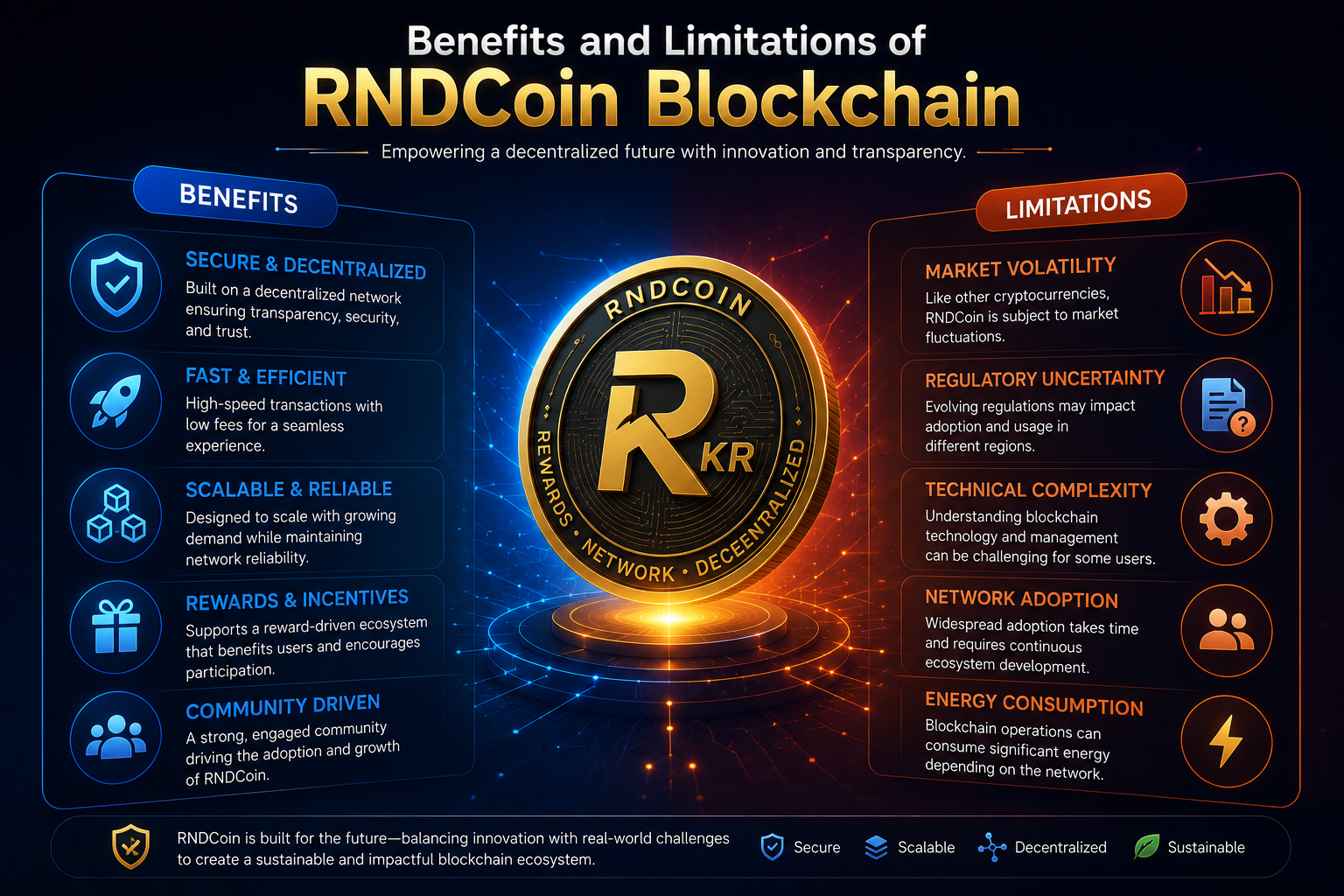 Honest breakdown of RNDCoin Blockchain benefits and limitations for crypto investors[/caption]
| Claimed Benefits | Verified Limitations |
|---|---|
| Energy-efficient PoS/DPoS consensus | No publicly confirmed whitepaper |
| Near-zero transaction fees | No verified independent security audit |
| Smart contract and dApp support claimed | No confirmed major exchange listing |
| Korean-language education fills real market gap | Founding team not publicly identified |
| ERC20 wallet compatibility if confirmed | Token trading volume negligible on available pairs |
| Cross-chain interoperability claimed | GitHub activity / code repository not publicly confirmed |
| Community governance participation | Price effectively at floor level on listed exchanges |
| Founded 2019 — some operational history | Technical claims unverifiable through blockchain explorer |
| Blockchain education content genuinely observable | KoFIU VASP registration status not publicly confirmed |