

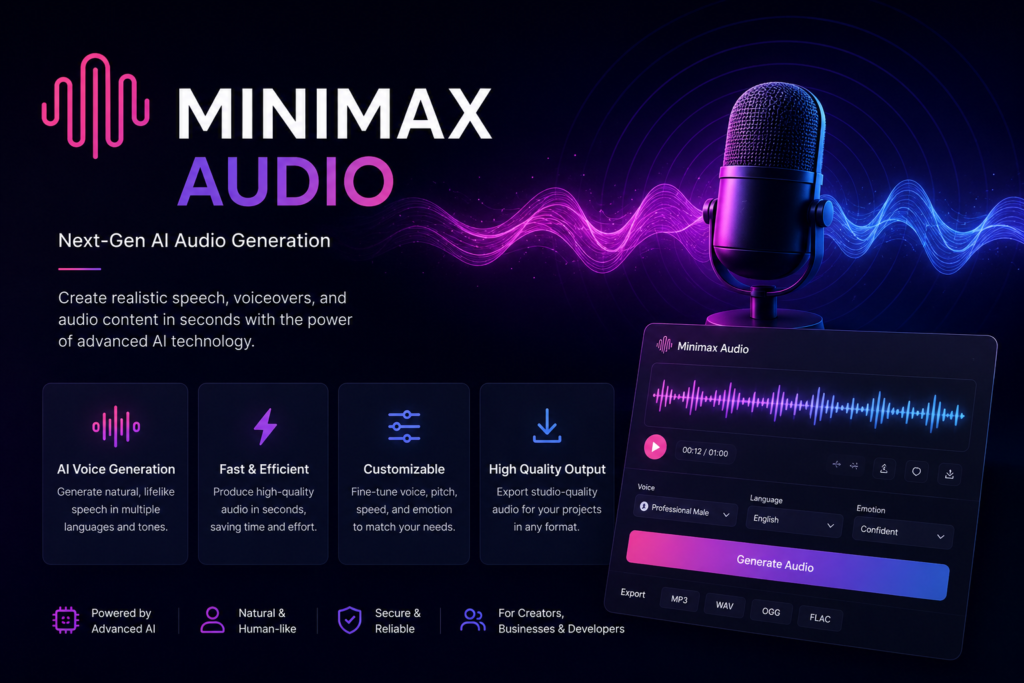
Neural Voice Cloning and Acoustic Model Training Infrastructure
Voice cloning inside minimax audio is built on zero-shot and one-shot adaptation frameworks. That means the system can generate a convincing digital voice replica from a minimal audio sample without requiring a transcribed script. Technically, this is achieved through a learnable speaker encoder that extracts timbre and spectral identity from raw waveform input. The encoder feeds latent vectors into a neural audio synthesis engine trained on diverse multilingual datasets. Acoustic model training relies on cross-lingual embeddings, enabling the system to preserve voice identity even when switching languages. This cross-language retention distinguishes minimax audio quality from traditional cloning tools that degrade consistency outside their primary language. Another critical layer involves emotional speech modulation. Instead of applying static pitch shifts, minimax audio modifies amplitude contours, harmonic structure, and temporal pacing at a granular level. Real-time sound optimization adjusts resonance peaks to simulate excitement, calmness, or urgency without distorting intelligibility. Behind this feature sits a hybrid DSP and neural network control layer. The DSP component ensures waveform stability while the neural model adjusts emotional nuance. In professional sound engineering workflows, this integration reduces post-processing requirements. Engineers can export broadcast-ready audio with minimal equalization because the synthesis stage already accounts for spectral balance and harmonic smoothing.AI Music Generation and Spatial Audio Integration
Beyond speech, minimax audio includes AI-driven music generation capable of producing both instrumental compositions and synchronized vocals. The generative engine likely uses transformer-based sequence modeling to map textual prompts into structured musical tokens. Unlike simple loop-based generators, the neural audio synthesis backend predicts chord progression, rhythmic segmentation, and melodic phrasing concurrently. For developers building multimedia environments, spatial audio integration becomes critical. minimax audio appears capable of rendering stereo separation and environmental reverb modeling, enabling immersive playback in VR or gaming contexts. High-fidelity audio processing in spatial frameworks requires careful phase alignment to prevent auditory fatigue. Sample rate conversion pipelines also play a decisive role in music generation fidelity. When generating long-form compositions, maintaining consistent 44.1 kHz or 48 kHz sampling without aliasing artifacts requires robust resampling algorithms. minimax audio incorporates optimized conversion layers to preserve harmonic detail during export. This becomes especially important when integrating output into cross-platform hardware acceleration systems. Mobile devices, web players, and desktop DAWs interpret sample buffers differently. minimax audio appears to adapt output formats to ensure compatibility without introducing latency spikes or compression degradation. For creators demanding professional sound engineering precision, such backend consistency matters more than flashy feature lists.Cross-Platform Performance and Hardware Acceleration
minimax audio operates primarily as a web-based platform but demonstrates cross-platform hardware acceleration compatibility. Modern browsers support WebAssembly and GPU-assisted rendering for computational tasks. For AI-powered audio tools, this translates into faster waveform generation and reduced CPU load during synthesis. Low-latency audio codec frameworks depend on efficient hardware utilization. By offloading certain matrix multiplication operations to GPU acceleration, minimax audio reduces rendering time for extended scripts or music sequences. This is particularly valuable in audiobook creation or enterprise-scale batch processing. High-traffic usage also requires scalable cloud infrastructure. When thousands of users simultaneously generate speech samples, backend servers must allocate dynamic compute instances. Elastic cloud orchestration prevents synthesis queues from stalling. High-fidelity audio processing consumes more resources than basic speech generation because harmonic modeling and noise reduction layers operate at higher computational intensity. minimax audio appears designed to scale horizontally, distributing synthesis tasks across containerized clusters. This architecture ensures stable performance even during peak demand. In a detailed minimax audio review, system scalability and hardware acceleration integration often determine whether the platform qualifies for professional deployment rather than hobbyist experimentation.minimax audio vs Competitors
| Feature | minimax audio | Traditional TTS Engines | Basic Voice Cloning Tools |
|---|---|---|---|
| High-Fidelity Audio Processing | Advanced neural waveform synthesis | Concatenative or limited neural | Partial neural |
| Low-Latency Audio Codec | Optimized real-time output | Moderate latency | Often unstable |
| Emotional Speech Control | Dynamic acoustic contour modeling | Limited preset tones | Basic pitch modulation |
| Zero-Shot Voice Cloning | Yes with minimal sample | Rare | Often requires long samples |
| AI Music Generation | Integrated multimodal engine | Not available | Not available |
| Cross-Platform Hardware Acceleration | GPU-aware web processing | CPU dependent | Limited support |
| Spatial Audio Integration | Stereo modeling & reverb layering | Mono-centric | Minimal |
Pros vs Cons of minimax audio
| ✅ Pros | ❌ Cons |
|---|---|
| Exceptional minimax audio quality | Advanced features may overwhelm beginners |
| Zero-shot voice cloning accuracy | Premium tiers required for full capacity |
| Real-time sound optimization | Heavy compute usage for long scripts |
| AI-powered audio tools ecosystem | Requires stable internet connection |
| Multilingual acoustic model training | Limited offline rendering support |