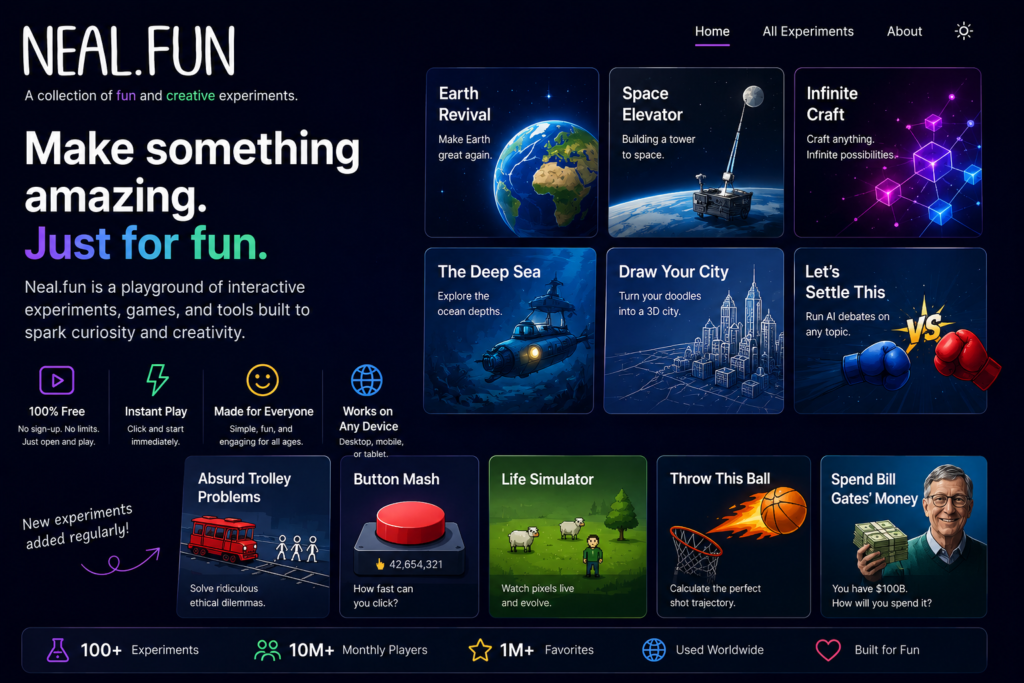
The neal.fun ,Neal Agarwal launched neal fun on October 26, 2017, while he was a student at Virginia Tech, initially as a personal platform to showcase his experimental web projects and creative coding explorations born out of boredom in lectures. What many casual visitors never realize is that Agarwal's journey into creative coding began far earlier than the site itself. Born in 1998, Agarwal developed an early passion for web design at age 10 by building personal sites to curate his favorite Flash games, self-teaching HTML, CSS, and later JavaScript amid the decline of Adobe Flash in the 2010s. His trajectory from WYSIWYG editors and Scratch knockoffs to full React-based javascript web apps reflects a rare, self-directed path that most CS graduates never take. He always used coding to express himself, and when formal education became about coding assignments and computational theory, he tuned out — he actually created neal fun because he was getting frustrated with coding for school instead of for fun. That frustration turned into one of the internet's most celebrated free browser games platforms, and the philosophy behind it has never changed. Self-funded and bootstrapped without external investors, neal fun adopted a minimalistic design philosophy that emphasized pure interactivity and joy over commercial features or monetization strategies beyond basic ads, allowing Agarwal to prioritize creative freedom.
Viral Web Simulators: Why neal fun Interactive Games Spread Like Wildfire
The virality of neal.fun isn't accidental — it's designed into the DNA of each project. Agarwal has been fascinated with data visualizations because they sit where code, art, and math meet. His goal with many projects is to visualize the world in new ways, and the web enables countless new types of data visualizations that are not possible in print — endless scrolling, unlimited scale, and animations are just some examples. This isn't a dev throwing JavaScript into a canvas tag and hoping for likes. Each neal fun interactive game is calibrated for shareability: The Password Game had streamers losing their minds on camera, Spend Bill Gates' Money turned abstract wealth into visceral, tangible choices, and The Deep Sea took static oceanic data and turned it into a vertigo-inducing scroll experience. One of the site's first games, Spend Bill Gates' Money, received attention with over 80 million page views. Based on search trends and social media engagement, Infinite Craft became the most viral project, earning the title of third most searched game in 2024. The Password Game also generated massive attention, particularly among streamers and content creators. The latest addition, Internet Roadtrip, represents an entirely new category of engagement. It's an innovative multiplayer game where thousands of players collectively control a virtual car through Google Street View. Created in 2025, this unique social experiment combines real-world exploration with collaborative decision-making, with players voting in real-time to navigate the vehicle, honk the horn, and tune local radio stations — described as "Twitch plays self-driving car." Each project taps a different psychological lever — curiosity, competition, absurdity, collaboration — and that diversity is exactly why neal fun's viral internet history projects keep reaching new audiences year after year.
neal.fun Traffic and Reach: The Numbers That Matter
Understanding the scale of neal.fun requires looking beyond surface-level stats. In March 2026, neal fun received 13.04 million visits with an average session duration of 10 minutes and 47 seconds. For context, most editorial websites struggle to hold users for 2 minutes. A nearly 11-minute average session on a free browser games platform with no account system, no social login, and no notifications is extraordinary. The site holds a global rank of approximately 4,602 and a U.S. rank of 3,148, with an authority score of 66. The top traffic source is direct traffic, driving 53.85% of desktop visits, followed by organic search. That direct traffic percentage is a critical detail — it means over half of visitors type the URL directly or use bookmarks, signaling genuine brand recall rather than search dependency. The audience skews 56.29% male and 43.71% female, making it one of the more gender-balanced gaming platforms on the web. Trust analysis reviews have given the site a trust score of 100 out of 100, and no major malware or phishing threats have been detected, with a long-term domain history and verified profiles supporting this assessment.
Pros vs Cons of the neal.fun Platform
| Pros |
Cons |
| Entirely free with zero account requirements — engaging digital mini-games with no paywalls or sign-up friction |
Ad-supported model means display ads can disrupt immersion on smaller screens |
| Minimalist UI with near-instant load times thanks to optimized client-side rendering and CDN delivery via Cloudflare |
No official mobile app for most games (Infinite Craft being an exception), limiting on-the-go access |
| Each project is a standalone creative web design experiment with unique mechanics — no cookie-cutter templates |
Projects are released infrequently since Agarwal develops solo, leading to long gaps between new content |
| Robust technical foundation (React, Node.js, MongoDB, Netlify) ensures reliable uptime and scalability |
No user accounts means no progress saving across devices for most games |
| Proven viral track record: multiple projects have achieved tens of millions of views organically |
Limited community features on the main site — no forums, no comments, no social profiles |
| Safe, trusted platform with a perfect 100/100 trust score and valid SSL certification |
Domain privacy registration may raise eyebrows for ultra-cautious users |
| Educational value recognized by classrooms, museums, and exhibitions worldwide |
Some experiences are heavily scroll-dependent and may not translate well to all screen sizes |
- The absence of account-based data persistence is both a privacy strength and a functionality weakness — session state in most neal fun interactive games relies entirely on browser-level
localStorage, meaning clearing cache wipes progress with no server-side backup.
- The solo-developer pipeline means every project gets obsessive attention to detail, but it also creates a single point of failure for maintenance, bug fixes, and server-side scaling during viral spikes — as seen when Infinite Craft required emergency rate-limit increases from Together AI.
neal.fun vs Alternative Simulators: Detailed Comparison
| Feature |
neal fun |
Poki |
CrazyGames |
Little Alchemy 2 |
Sandboxels |
| Core Focus |
Creative web design experiments and viral web simulators |
Aggregated third-party casual browser games |
Aggregated HTML5 and Unity WebGL games |
Element-combination puzzle game |
Pixel-based physics sandbox |
| Developer Model |
Solo indie creator (Neal Agarwal) |
Platform/publisher hosting external devs |
Platform/publisher hosting external devs |
Small studio (Recloak) |
Solo indie creator (R74n) |
| Tech Stack |
React, Node.js, MongoDB, Netlify, Cloudflare |
Multi-framework aggregator |
Multi-framework aggregator |
Custom JavaScript engine |
Custom JavaScript/HTML5 Canvas |
| Account Required |
No |
Optional |
Optional |
Optional |
No |
| AI Integration |
Yes (LLaMA 2, Together AI for Infinite Craft) |
No native AI |
No native AI |
No |
No |
| Monetization |
Minimal display ads |
Ads + premium tiers |
Ads + premium tiers |
Ads + in-app purchases |
Free / open source |
| Average Session Duration |
~10:47 minutes |
~5-7 minutes |
~5-8 minutes |
~8-10 minutes |
~6-9 minutes |
| Educational Use |
Documented classroom and museum adoption |
Limited educational value |
Limited educational value |
Moderate educational value |
Moderate educational value |
| Project Variety |
35+ unique standalone experiences |
Thousands of aggregated games |
Thousands of aggregated games |
Single game |
Single sandbox with modes |
| Mobile Support |
Responsive web; limited native apps |
Full mobile support |
Full mobile support |
App available |
Responsive web |
- The fundamental difference between neal fun and aggregator platforms like Poki or CrazyGames is authorship — every project on neal fun is hand-crafted by a single developer with a consistent design language, while aggregators curate third-party titles with wildly varying quality, UI patterns, and technical standards.
- neal fun vs alternative simulators shows that AI integration (as seen in Infinite Craft) and real-time multiplayer social experiments (Internet Roadtrip) place the platform in a category that pure game aggregators simply don't occupy — it's closer to an interactive art gallery than a gaming portal.
The Design Philosophy: Minimal User Interface Architecture as a Feature
Agarwal has described himself as a minimalist at heart, stating that his dream setup would be the fewest things possible — ideally invisible to him so he could focus entirely on the creative work. That philosophy bleeds directly into every pixel of neal fun. There are no hamburger menus, no onboarding flows, no tutorial pop-ups. The homepage is a grid of thumbnails. Click one, and you're immediately inside the experience. This minimal user interface architecture is not laziness — it's an intentional design constraint that maximizes time-to-engagement and eliminates cognitive friction. For a platform generating 13 million monthly visits, the restraint is remarkable. Agarwal's creative process involves getting a minimal version of an idea working early on, with the goal of validating or invalidating it before committing too much time. From there, it's "basically just experimentation and alchemy." This rapid prototyping approach explains why the platform's engaging digital mini-games feel so polished despite being developed by one person. Every scroll event, every drag interaction, every animation curve has been iterated through what Agarwal calls an alchemical process — a blend of technical problem-solving and creative intuition that produces experiences like The Deep Sea's parallax depth illusion or The Size of Space's logarithmic zoom scaling. The result is a portfolio of creative web design experiments that feel inevitable in their simplicity, even though each one required solving unique rendering, data, and interaction challenges.
What Makes neal.fun Interactive Games Technically Distinct
Beyond the surface-level charm, what separates neal fun from typical browser games is the engineering approach to each project as a bespoke web application rather than a game built on a reusable engine. Projects like Internet Roadtrip exemplify a shift toward participatory formats, allowing global users to collaboratively navigate a virtual car across Google Street View in real-time, fostering emergent, user-generated exploration. The technical stack behind this involves real-time websocket connections for vote aggregation, Google Maps API integration for panoramic rendering, and sophisticated option-picking logic that determines available directions based on Street View coverage data. The JavaScript library internally calls GetMetadata and SingleImageSearch endpoints, which handle panorama resolution and heading calculations. For Infinite Craft, AI software such as LLaMA and Together AI are used to produce new items, but the real engineering elegance lies in the caching layer that prevents redundant API calls while maintaining instantaneous client-side game performance. Each element is limited to a maximum of 20 LLaMA-2 tokens, and elements longer than 30 characters fail to combine with anything — a preventative measure against excessively long sequences. These aren't arbitrary limits; they're deliberate guardrails that balance creative freedom with computational cost and abuse prevention. The Password Game, meanwhile, used stateful client-side validation logic that tracked dozens of evolving rules simultaneously — a front-end architecture problem closer to form-validation engines in enterprise software than anything you'd expect from an indie game. Each project on neal fun is essentially a standalone javascript web app with its own data model, interaction paradigm, and performance profile.
Frequently Asked Questions (FAQ)
Q1: Is neal.fun safe to use? Yes — neal.fun appears to be low-risk based on current analysis. No major malware or phishing threats have been detected, and a long-term domain history plus verified profiles support this assessment. The site uses SSL encryption and is hosted behind Cloudflare's security infrastructure.
Q2: What technology stack does neal.fun use? The platform is built with React for front-end rendering, Node.js and MongoDB for backend and data needs, and is hosted on Netlify. DNS and CDN services are handled by Cloudflare, and AI-driven projects like Infinite Craft integrate with external LLM providers like Together AI.
Q3: Does neal.fun work on mobile devices? Most projects are responsive and functional on mobile browsers, though some scroll-heavy or drag-based experiences perform best on desktop. A common challenge in development is that an idea works on large screens but not on mobile, or vice-versa, and Agarwal addresses this on a per-project basis.
Q4: Do I need to create an account to play? No. neal.fun requires zero registration, login, or personal information. All projects are accessible immediately upon loading the page. Game progress for most experiences is stored in local browser storage.
Q5: How does Infinite Craft generate new elements? Infinite Craft integrates a large language model (LLM) to handle its core mechanic. When a player combines two elements, the AI analyzes the concepts and generates a new, often surprising, result. Previously discovered combinations are served from a cache for instant responses.
Q6: How often does neal.fun release new projects? There's no fixed release schedule. Agarwal develops solo and releases projects when they meet his quality standards. Major releases have included The Password Game (June 2023), Infinite Craft (January 2024), and Internet Roadtrip (May 2025).
Q7: Can I use neal.fun in a classroom or educational setting? Absolutely. Projects like The Deep Sea and The Size of Space have been adopted in classrooms, exhibitions, and museums for their data visualization quality. The platform is ad-supported but free, with no inappropriate content.
Q8: What browser works best for neal.fun? Agarwal primarily uses Chrome during development, making it the most thoroughly tested browser. All modern browsers (Firefox, Safari, Edge) are supported, though Chrome and Chromium-based browsers typically deliver the best performance for WebGL and Canvas-heavy projects.